Showing posts with label insurance. Show all posts

Tuesday, October 12, 2010

Camp Edgewater, Lake Titus

Editor's Note:  Steven Bryan, son of Eleanor Hale Bryan (dau. of Robert Hale, son of G.H. Hale) noted our reference to the extensive collection of O'Neil and Hale Insurance materials at the Franklin County Historical and Museum Society in previous posts and brought by a small sample of his Hale Family materials.  We are indebted to him for sharing these materials with us.

The Hale-French camp on Lake Titus, "Edgewater," was established in 1891 by Hiram F. and Hannah E. French, who purchased the property from the esate of A.B. Parmelee.  Ownership passed to their children, Gertrude French Hale and Calvin A. French, in 1903 and then in 1941 to Robert F. and Dorothy Stephenson Hale and Eleanor French.  In 1951 Robert and Dorothy Hale took full ownership, and the camp was sold out of the family in 1979.  [L.M. House, et al. (2005) Our Lake Titus. Potsdam, NY:  Parkhurst Brook Publishers.  P. 280]

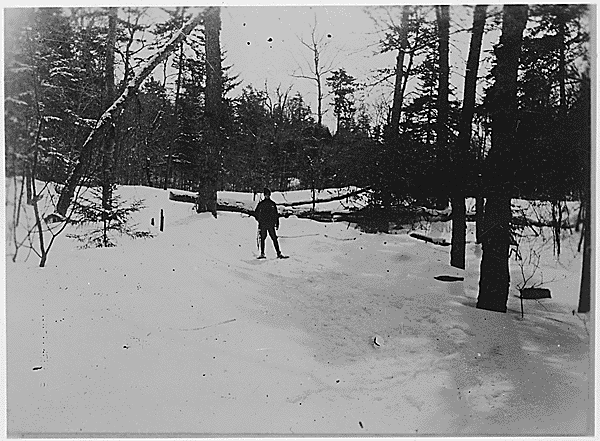
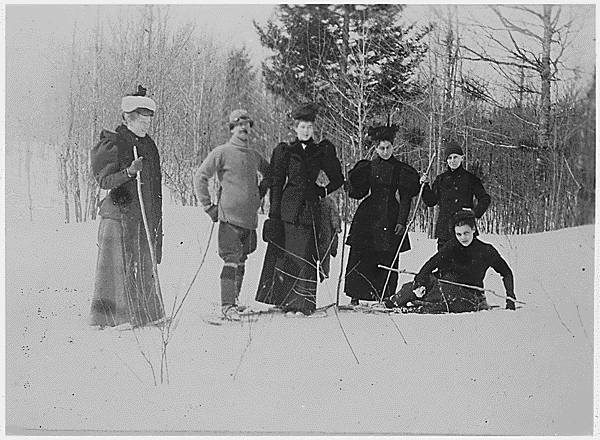
The Hale and French families, and their many guests, logged their days at Camp Edgewater in a series of "camp books" that include photos, poems, sketches and narrative entries describing the weather, visitors and daily activities at camp.  The set of camp books spans nearly the entire time Edgewater was in the family, from 1891-1979.  The entries paint a colorful picture of life on Lake Titus, from trails hiked to fishing holes plumbed, to games played.

Robert Hale, Libe Washburn, Calvin French, J. Stewart Gibson at "Community Flag Pole" at Lake Titus, ca 1933
(click image to enlarge)

This entry from August 1, 1924 reads:
Although I have known Lake Titus for many years yet my present visit has impressed me more vividly than ever before with its many charms.  Instead of losing its wilderness characteristics by the passage of the years and the increasing occupation of its shores by people the lake has developed a still greater appearance of unspoiled seclusion.  The lovely forests clothing its shores and the embracing hills continue to grow and extend a sheltering fellowship to the homes set in their midst and to welcome the people to one of nature's delectable places.  To the wayfarer like myself Camp Edgewater with its dear and friendly habitants adds the human touch that makes a sojourn here an added joy and departure a gloom.  
-  EW Nelson  August 1/24
Another entry, this one from September 3, 1923:

It reads:
"Labor Day, Sept 3rd, 1923.
The Day we leave.  "The best summer yet" was the unanimous vote at the breakfast table on this the last morning of the vacation of 1923.  Good health, good eats, good funs, much gaming (mostly Mah Jongg) and dancing have all helped to make glad the days that have passed all too swiftly.  A pleasnat time was had by all on two grand picnics; one on Brown's Mountain, the other on Owl's head Pinnacle; not to forget the most enjoyable expedition to Skerry and Coat Hill.  Many fine hikes have been particiapted in by various members of the camp - some along familiar trails and some over new territory.  "Yes, we have no bananas to-day," "Beale Street Momma," "Barney Google" and other classical melodies have enlivened our spirits and our feet at early morn and late at night.  Only ten months till we come again.  Hasten the glad day."
The Mah Jongg set mentioned in this entry is still owned by Nancy Hale:


The temperatures and barometer readings recorded daily during the summer of 1923:


This 1934 poem by Dorothy S. Hale indicates that recording the weather thus was routine at Edgewater:
      THE CHART KEEPER
One panel in the living room is lined
With weater charts full ten years old and more.
And all the years my memory serves there's been
Beside the wet thermometer upon the wall,
A paper neatly lined and numbered off
Showing the days both passed by and to come:
And those passed by all neatly written in: -
What wind- what sun and what precipitation.
----------------------------------------------
Other Resources:
- June 11, 1885 Malone Palladium article by A.B. Parmelee recalling an 1842 excursion to Lake Titus
- "History of Lake Titus" by Robert F. Hale in Franklin Historical Review, vol. 6, 1970.
-  L.M. House, et al. (2005) Our Lake Titus. Potsdam, NY:  Parkhurst Brook Publishers.
- Lake Titus Potpourri by Frances Willson Daily

Tuesday, August 31, 2010

Map of Loon Lake Hotel property

The Franklin County Historical and Museum Society is hosting Joseph LeMay on September 3, 2010 at 6:30pm for a discussion of the history of Loon Lake, NY.   The event is free and open to the public.  If you have your own photos and memories of Loon Lake, and especially of the Loon Lake House hotel, please bring them to share.  We'll be meeting in the Schryer Center behind the museum at 51 Milwaukee St., Malone.  Call 518-483-2750 for more details.

This map of the Loon Lake Hotel and associated buildings in 1940 is in the collection of the Historical Society.  It is part of an extensive collection of maps and drawings of structures from the O'Neil and Hale Insurance Agents of Malone. 

1968.462.78
Click Image to Enlarge

Previous posts and other web resources on Loon Lake, NY:


Friday, May 14, 2010

Franklin County Poorhouse

Franklin County first operated a poor house in Malone in 1830, when the county supervisors rented a small farm.  The next year they appropriated $2000 to purchase a building, which burned in 1845 and was rebuilt.  The county replaced this smaller wood structure with a large brick and stone poorhouse 2 miles west of the center of the village, which collapsed after years of disuse in 2002.  Many readers will remember it as the "old county home." 


Franklin County statistics from 1823 from the NYS Annual Report of the State Board of Charities For the Year 1900:

click to enlarge


"This house is located about two miles from the village of Malone. The building is of wood, poorly constructed, and illy fitted for its present uses. It was originally a farm house, and in size 80 x 24 feet, two stories high. There is attached a farm of 110 acres, yielding a revenue of $1,500. The basements of the building are occupied for domestic purposes only. In the house are eighteen rooms or wards, well warmed by stoves, but without ventilation. From one to eight paupers are placed in a single room. The number of inmates was thirty-eight, fifteen males and twenty-three females. Of these twenty-eight are foreign, ten native born; nine are under sixteen years of age. The sexes are separated at night, but mingle together during the day. The average number of inmates is forty-eight, supported at an expense of thirty-one cents per week each, exclusive of the products of the farm. The paupers are employed, the men on the farm, the women about the house. It has been visited once during the year by the board of supervisors. They regulate the government of the house and the system of diet. The food of the paupers is of a plain and wholesome quality. The house is supplied with Bibles, but there is no regular religious instruction. A teacher of the common English branches was employed in the house for three months during last winter, but the children usually attend the district school. A physician is employed by the year at $28, and comes only when called. There are no facilities for bathing. One birth and two deaths have occurred during the last year. No contagious diseases have raged. Of the inmates seven are lunatics, three males and four females, all paupers, none are reported improved or cured. But one is constantly confined, and he in a cell. They are restrained by confinement, and sometimes handcuffs, shackles, and the straight jacket are used. Two have been admitted within the year. They receive no medical or other attendance, nor does the house permit classification. The superintendents usually discharge the insane; sometimes the power is exercised by the keeper. Two of the paupers are blind, four idiots--two male, two female. The keeper reports nine-tenths of the paupers as here by reason of intemperance and its effects. There is here a poor cripple, almost idiotic, whose limbs are drawn up and under him in strange contortions, and his tongue paralyzed by the disease. He can wear no garments but a loose shirt. The unnatural parents were committed to prison, and the child sent to this house.  The hospital department of the house is wretched, and the nursing and medical attendance inadequate. The general appearance of the establishment however is good, and the rooms are particularly neat and clean."

From the 1901 Meigs & Hadley insurance agents policy book (Franklin County Historical & Museum Society collection, 1975.60):


From the 1870  NYS Code relating to the Poor, p.127:


The April 13, 1879 New York Times reprinted a short article from the Penn Monthly quoting facts from a report of the horrific conditions under which the insane in NYS poorhouses suffered.  The writer colorfully introduced the subject thusly:
"Since the days that the curse of slavery was wiped off the land, no subject so full of horrors was ever afforded to human pen.  There is no standard of misery by thich this can be measured.  The wretchedness of these poor creatures seems a realization of a Dantesque ideal."
The most mild of the poorhouses listed, "in Franklin County, two or three sleep on straw without other bedding.  In the day-time the sexes mix as they please.  They have no change of undergarments."

However, the 1/10/1925 Adirondack News reported favorable aspects of the recent NYS Board of Charities inspectors' report: 
"A significant feature of the report is that recent admissions have been confined to old and decrepit persons, and that the younger type of alcoholics is no longer present.  It says:  'Administrative conditions as to cleanliness and care of inmates are excellent.  The institution has a home-like atmosphere.  The relation of employees to inmates seems considerate, reflecting well-regulated local supervision.'"
____________
See: 
-  Seaver, F. (1918) Historical Sketches of Franklin County.  Pp 78-79.
Herald and Adirondack Mt. Press, Tupper Lake, 9/22/1927
Poorhouse History website

1901 Village of Saranac Lake

From the Meigs & Hadley insurance book, ca. 1901 (from the collection of the Franklin County Historical & Museum Society (1975.60):
Village of Saranac Lake


click to enlarge

Tuesday, February 9, 2010

Columbian Fire Insurance Company

The Franklin County Historical and Museum Society has in its collection (1975.72.1) a ledger of the O'Neil and Hale Insurance Agents, Malone, NY who were local agents for the Louisville, KY Columbian Fire Insurance Company.  This ledger from 1893-4 includes the policies of individuals and businesses from every corner of Franklin County.  From the Town of Bombay's policy insuring their covered bridge at Hogansburg

To the Tupper Lake Village school district #1 (formerly the town of Altamont) two-story school building:


Both structures were insured for $1250.00 with a November 14, 1893-November 14, 1894 policy.  The premiums on these policies were $18.75

O'Neil and Hale did a good business with the hotels in the county, selling policies to Loon Lake House:
the Berkley Hotel in Saranac Lake:

and Paul Smith's Hotel in the town of Brighton:

...among others.

Click on images to enlarge